
The Invisible Mistake Sabotaging Renovations (and No One Admits It)

There’s a silent problem haunting anyone about to renovate a home, whether architect, investor, developer, or an owner preparing a flip.
It’s not the contractor.
It’s not the budget.
It’s not the permits.
It’s something much more basic:
People make critical decisions without actually knowing how the project will look in the end.
It’s like entering a high-risk deal without seeing the investor pitch. It’s playing the “we’ll see at the end” game. It’s the real-estate equivalent of roulette.
And this invisible mistake costs time, money and, worse, resale value.
The good news?
There’s a way to eliminate this uncertainty—and fewer than 20% of people are using it. Let’s dive in.
1. “Is the Layout Right?” — The Question Nobody Wants to Ask Out Loud
In a renovation, the layout is the heart of the project. And yet, 7 out of 10 layouts are approved based on… 2D floor plans.
Data from the National Association of Realtors shows that more than 82% of buyers struggle to interpret floor plans, even when they’re simple.
Now imagine standing in front of a 3-bedroom home with walls coming down, an open kitchen and a redesigned circulation. You’re asking someone to predict the future from a pencil sketch.
And that’s where everything goes off track:
Corridors that seem functional on paper but feel claustrophobic in reality
Supposed “open-concept” kitchens that end up dark
Living rooms that seem spacious… until the sofa arrives
Lack of vision creates insecurity.
Insecurity creates delays.
Delays create costs.
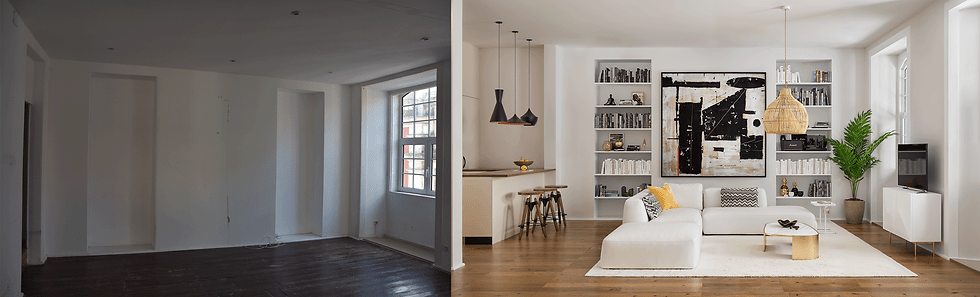
3D visualization? It lets you test everything before touching a single wall. Circulation, scale, natural light, flow, everything.
It’s not guessing. It’s informed decision-making.
2. The Kitchen: The Riskiest Space to Design (And Where People Lose the Most Money)
There’s a reason why 90% of flippers and professional investors always start with the kitchen:
It’s the space that sells the most.
But it’s also where the biggest mistakes happen, because every choice has direct impact on market value:
A poorly oriented kitchen can reduce the final price by up to 8%.
Materials misaligned with the right audience can increase time on market by 30%.
Poor layouts lead to costly replacements during construction—doors that clash, misplaced peninsulas, lack of storage.
And the classic doubt:
“Do you think this kitchen appeals to the right buyer?”
Without 3D, it’s pure instinct. With 3D, it’s market-driven design:
You show options
Test styles
Validate trends
Optimise visual impact
Architects, builders and buyers instantly understand whether a kitchen will “sell”—before spending a single euro on construction.

3. The Psychology of Decision-Making On-Site: Why Clients Freeze When They Can’t See Anything
Decision-making on site has a rational side… and an emotional one that few admit.
Harvard published a study showing that 95% of purchase decisions are emotional, not logical. And renovating a home is emotional from start to finish.
When someone can’t visualise the outcome, this happens:
They postpone decisions
Change their mind halfway
Feel insecure
Slow down the construction
Keep teams waiting (sometimes for days)
The famous: “I’m not sure… let’s think a bit more.”
3D visualization eliminates this freeze instantly. You show the final version—with light, materials, ambience, details.
And the client says: “Yes. That’s it.”
Decision made → work moves forward → fewer delays → fewer unexpected costs.
4. Let’s Renovate the Way We Renovate: The Strategic Power of 3D Visualization
3D visualization is not a luxury. It’s a strategic tool, just like a pre-defined budget or a clear project timeline.
For investors:
👉 reduces risk and accelerates sales. Simple.
For architects:
👉 improves communication and reduces rework.
For flippers:
👉 lets you test ideas, validate styles and present a final product with a wow factor.
For the end client:
👉 gives clarity and prevents regret.
And for the market?
👉 It raises the bar.
👉 Professionalises.
👉 Democratizes good decision-making.
The real question is no longer “How much does a render cost?”
The real question is:
“How much does it cost to decide blind?”
What You Can Apply Today
Right now, before starting a renovation, do this:
Choose one critical room (kitchen, living room or suite).
Define 2–3 layout options.
Request comparative 3D visualizations.
Analyse real impact: circulation, light, feeling, scale.
Decide with confidence, not intuition.
If you do just this, you’ll reduce 70% of uncertainties and avoid most expensive renovation mistakes.
And if you want support to bring your vision to life, test ideas or prepare an irresistible project to sell, Hugo Guerra Design is here to take your project from “maybe” to “definitely.”
Comments